




Workforce records
People, roles, skills, documents and workforce history.
Connected workforce context. Controlled intelligence. Accountable action.
Explore the architecture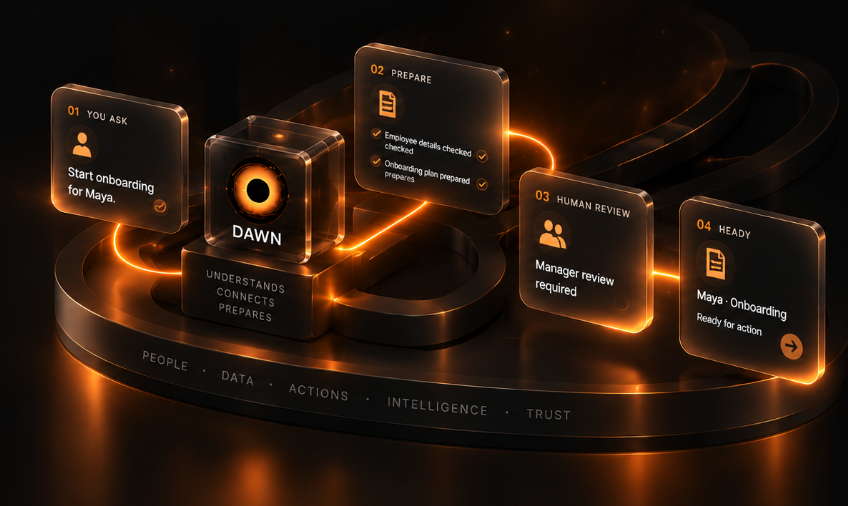
Records, intelligence, actions and evidence share the context of the work.
People · Work · Skills · Trust
People, roles, skills, documents and workforce history.

Relevant insights, recommendations and workforce context.

Tasks, approvals, notifications and operational processes.

Permissions, approvals, verification and clear records.
DAWN separates understanding a request from having the authority to act on it.
Relevant records and the purpose of the request shape what the AI receives.
Structured proposals pass through permitted tools and review requirements.
A capability gateway separates model selection from workforce workflows.
Live media, speech and reasoning work through separate boundaries, with readiness checked before a live interview starts.
A controlled live session.
Audio and turn management.
Validated speech events.
A request through policy.
The response as audio.
Backend admission checks readiness before issuing access to the live conversation.
Streaming speech events are validated before they enter the durable interview record.
Carrier acceptance and call completion have different states. Ambiguous outcomes do not trigger another automatic call.
DAWN prepares the work and presents the supporting evidence. The right person reviews the decision.
A personal identity and an organisation membership have different responsibilities. Permissions determine the scope of each request.
A person can hold different relationships without losing the distinction between personal identity and organisation access.
Roles and resource checks determine access. A screen or model suggestion cannot grant permission.
Provider credentials stay behind the backend. Live room access uses scoped, backend issued credentials.
Bring relevant information from recruitment, HR and payroll into one connected view.
PayrollATSHRISThe context stays connected.
Connected workforce context
Business records, documents, media and asynchronous work have distinct responsibilities and recovery paths.
Relational records and versioned migrations give workforce activity a consistent business foundation.
Documents and recordings use dedicated storage paths, separate from AI reasoning.
Background processing separates accepted requests from work that still needs to complete.
Idempotency and signed callbacks help prevent duplicate calls and confused outcomes.
Validated final speech events and durable interview turns provide a recovery point.
The platform core records domain events alongside business changes, preserving the link between them.
Keep the context connected as people join, develop, work and move on.
The architecture makes responsibility explicit, including what happens when a dependency fails.
Workforce records belong to business services. A model response is not an authoritative record change.
Capability routing distinguishes provider failures from request failures, so recovery follows the right boundary.
Idempotency keys and explicit states distinguish a retry from a second business action.
Tool permissions and human review keep sensitive outcomes separate from generated suggestions.
Usage records, call status and review states distinguish accepted, completed, failed and uncertain work.
AI, media and external adapters sit behind contracts, reducing the need to rewrite business workflows.
We plan to train and adapt open source models on approved DAWN data, with training and inference inside a private environment.
Use approved data with clear rights, access and retention rules for each training purpose.
Adapt models within a controlled environment, with evaluation and access built into the process.
The goal is to keep workforce data within infrastructure controlled by DAWN instead of sending it to external model services.
The platform blueprint gives business services, AI, media and integrations distinct ownership while preserving their shared contracts.
Keep related business transactions together. Extract a service when its ownership and operating needs justify it.
API, event and tool contracts define what each part of the system can expect.
The engineering gate follows a journey through the interface, API, records, permissions and recovery.
Start with the work your team needs to get done.


